
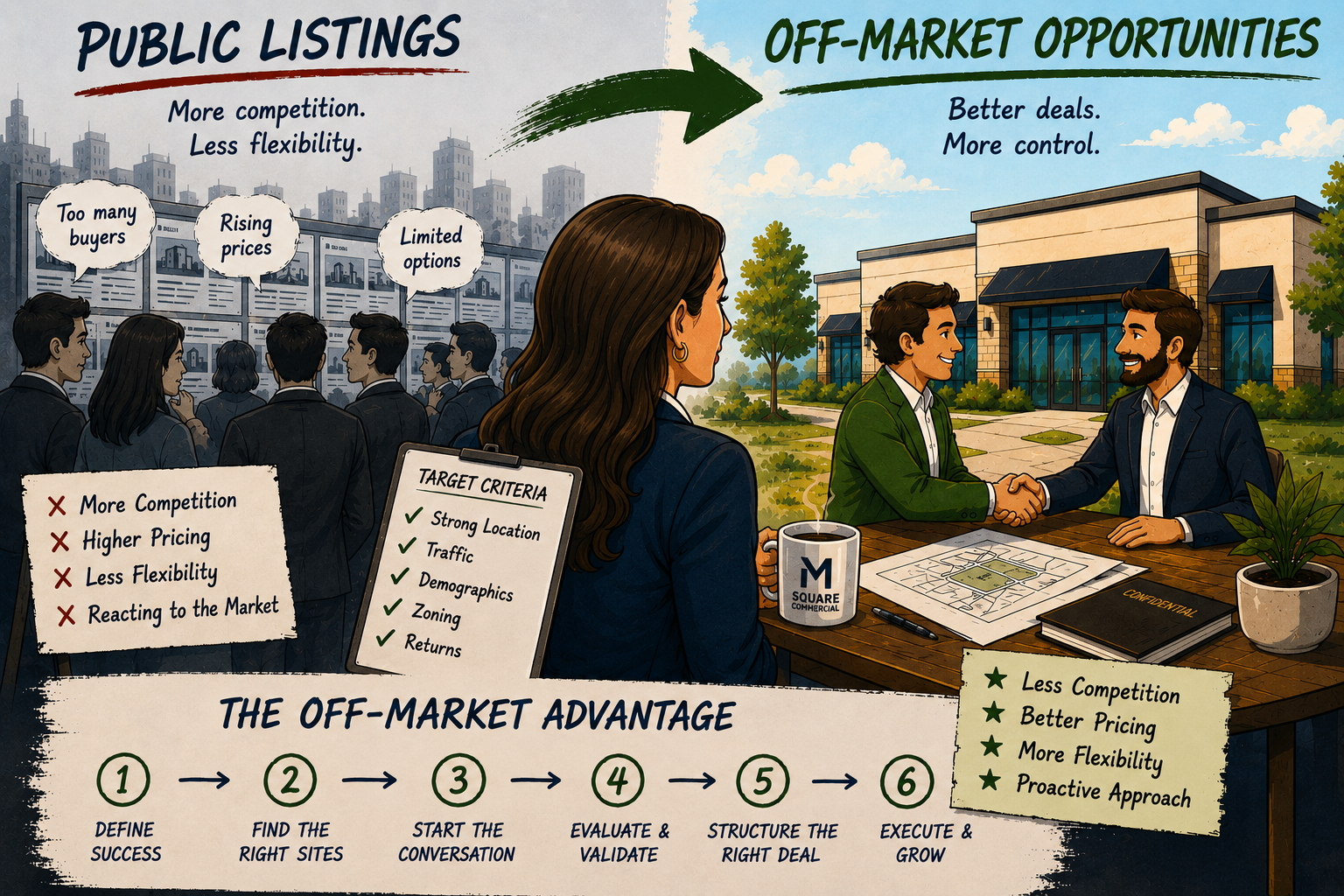
In today’s commercial real estate environment, the most valuable opportunities are rarely the ones you see online. By the time a property hits platforms like LoopNet, Crexi, or CoStar, it has already been exposed to the market, creating competition, compressing pricing, and limiting flexibility in deal structure.
For developers and tenants focused on growth, that model creates friction. You’re competing for the same inventory as everyone else, often reacting instead of controlling the process. That’s where off-market opportunities become critical.
Off-market commercial real estate refers to properties that are not publicly listed, but where ownership may be open to selling or leasing under the right circumstances. These opportunities don’t sit in a database waiting to be discovered—they are uncovered through relationships, direct outreach, and a clear understanding of what makes a site viable. In many cases, the owner isn’t actively marketing the property at all. The opportunity only exists because someone initiated the conversation.
This is especially relevant in retail and net lease development, where site quality is everything. The best corners, the strongest traffic patterns, and the most strategic infill locations are often controlled by long-term owners who have no reason to list publicly. If you rely solely on marketed deals, you’re often choosing from what’s left—not what’s best.
Off-market sourcing changes that dynamic. It allows developers and tenants to pursue specific sites that align with their criteria, rather than waiting for something close enough to become available. It also creates a more controlled negotiation environment. Without a fully marketed process, there is typically less competition, more flexibility in timing, and greater ability to structure deals in a way that supports both sides. For developers, that can mean better basis and stronger yields. For tenants, it can mean securing locations that competitors never had access to.
That said, off-market transactions require a different level of discipline. There’s no centralized visibility, no polished offering memorandum, and often limited initial data. You have to build the opportunity from the ground up—identifying the site, understanding ownership, validating the real estate, and structuring a path forward. Pricing is less about comps on a screen and more about experience in the market. Execution depends heavily on how well the process is managed and how relationships are handled along the way.
At M Square Commercial, we approach off-market sourcing as a systematic process, not a one-off effort. It starts with clearly defining what a successful site looks like for the client—whether that’s a retail tenant expanding into a new market or a developer targeting a specific return profile. From there, we identify locations that meet those criteria and go directly to ownership. In many cases, this means reaching out to owners of underutilized sites, excess land, or properties that haven’t transacted in decades.
At the same time, we stay closely connected to local brokers, attorneys, lenders, and other professionals who are often aware of opportunities before they reach the broader market. These relationships provide early insight into situations where a sale is being considered but not yet formalized. We also leverage data—public records, ownership profiles, and market analytics—to identify patterns that signal potential movement, such as absentee ownership or upcoming lease changes.
Equally important is aligning every opportunity with execution. A site is only valuable if it can actually move forward. That means understanding tenant requirements, development constraints, and deal economics upfront—not after the fact. Our role is to bridge that gap, ensuring that what we source is not just interesting, but actionable.
Off-market opportunities are often described as “hidden,” but that’s not entirely accurate. They’re not hidden—they simply require a more intentional approach. They require consistency, local knowledge, and a willingness to initiate conversations that others don’t.
For developers and tenants looking to scale efficiently, this is where a real advantage is created. It’s not about chasing deals—it’s about creating access to the right ones.





Leave A Comment